Engdaget Legesse
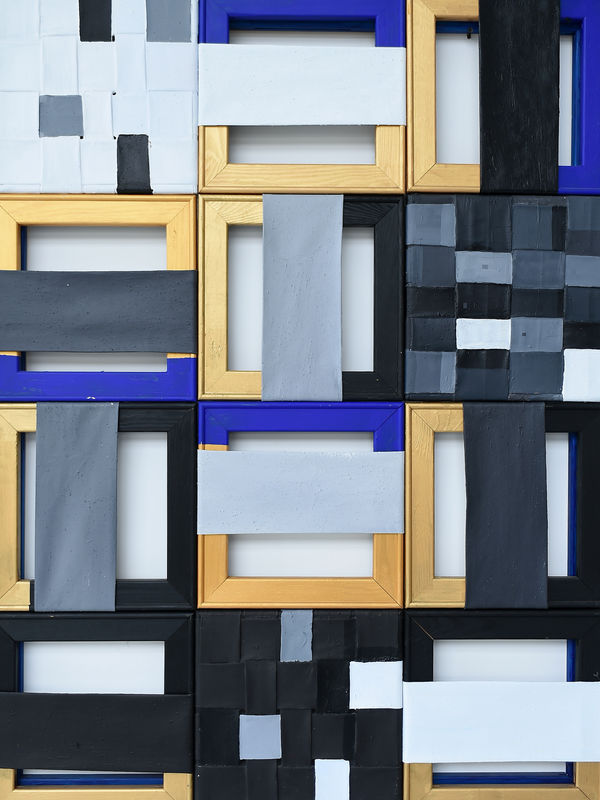
Black and White in Gold and Blue Frame, 2020
Acrylic on strip canvas
47 1/4 x 35 3/8 in
120 x 90 cm
120 x 90 cm
I work with leftover canvas from art stores, cutting it into strips and
weaving it into forms that sit somewhere between painting, sculp-
ture, and installation. These fragments once overlooked or discarded,
take on new life through the act of weaving. The vertical and horizon-
tal movements create their own quiet structure, a kind of architec-
ture shaped by tension, rhythm, and presence. Each surface
becomes a new terrain, formed by the push of my hand and the
resistance of the material.
For me, weaving is a way of exploring time, memory, and experience.
Every strip is a gesture, every intersection a meeting point where
moments overlap and reshape one another. Through this repetitive,
meditative process, the canvas becomes a record of passing time,
built slowly through attention, labor, and care.
Time in my work doesn’t move in a straight line. It folds, stretches,
loops, and fractures, much like the woven surfaces themselves. By
transforming discarded material into these new structures, I think
about how memory is carried, how identity is formed, and how time
leaves traces on both matter and thought. The work becomes a
quiet place where the passage of time, both seen and unseen, can be
felt and imagined.
weaving it into forms that sit somewhere between painting, sculp-
ture, and installation. These fragments once overlooked or discarded,
take on new life through the act of weaving. The vertical and horizon-
tal movements create their own quiet structure, a kind of architec-
ture shaped by tension, rhythm, and presence. Each surface
becomes a new terrain, formed by the push of my hand and the
resistance of the material.
For me, weaving is a way of exploring time, memory, and experience.
Every strip is a gesture, every intersection a meeting point where
moments overlap and reshape one another. Through this repetitive,
meditative process, the canvas becomes a record of passing time,
built slowly through attention, labor, and care.
Time in my work doesn’t move in a straight line. It folds, stretches,
loops, and fractures, much like the woven surfaces themselves. By
transforming discarded material into these new structures, I think
about how memory is carried, how identity is formed, and how time
leaves traces on both matter and thought. The work becomes a
quiet place where the passage of time, both seen and unseen, can be
felt and imagined.
Engdaget Legesse
